
You Can't Regulate What You Can't Identify: Why Emotional Vocabulary Matters
“Fine” Isn’t an Emotion
One of the things I often do in therapy is temporarily ban the word fine.
Not because it’s a bad word, but because it doesn’t actually tell us much about what is going on emotionally.
When I ask clients how they feel about something, I often hear responses like “fine,” “okay,” “good,” or “eh.” Sometimes, when I press a little further, I might hear words like “stressed,” “upset,” or “frustrated.”
There is nothing wrong with these responses. The problem is that many of us were never really taught how to identify emotions beyond a very basic level.
We learned happy, sad, mad, and scared. Maybe as we got older we added a few more words like stressed, overwhelmed, lonely, or frustrated.
But emotions are much more complex than that.
And honestly, even in basic everyday greetings of “How are you doing?” I notice the same pattern. I’ll respond with “good,” as my inner therapist is reminding me that good is not an actual answer. Good isn’t even a feeling. It tends to be more of a default response rather than an accurate reflection of what is actually going on internally.
We Can’t Name What We Don’t Have Words For
Imagine trying to describe every color you see using only a handful of color names.
You could probably get close, but you would miss a lot of the detail.
The same thing happens with emotions.
Sometimes what we call anger is actually hurt.
What we call anxiety may be uncertainty.
What we call frustration may be disappointment.
When we don’t have the vocabulary to accurately describe what we’re feeling, we often become disconnected from our emotional experiences. We know something feels uncomfortable, but we struggle to identify exactly what it is.
Emotions Don’t Exist in Isolation
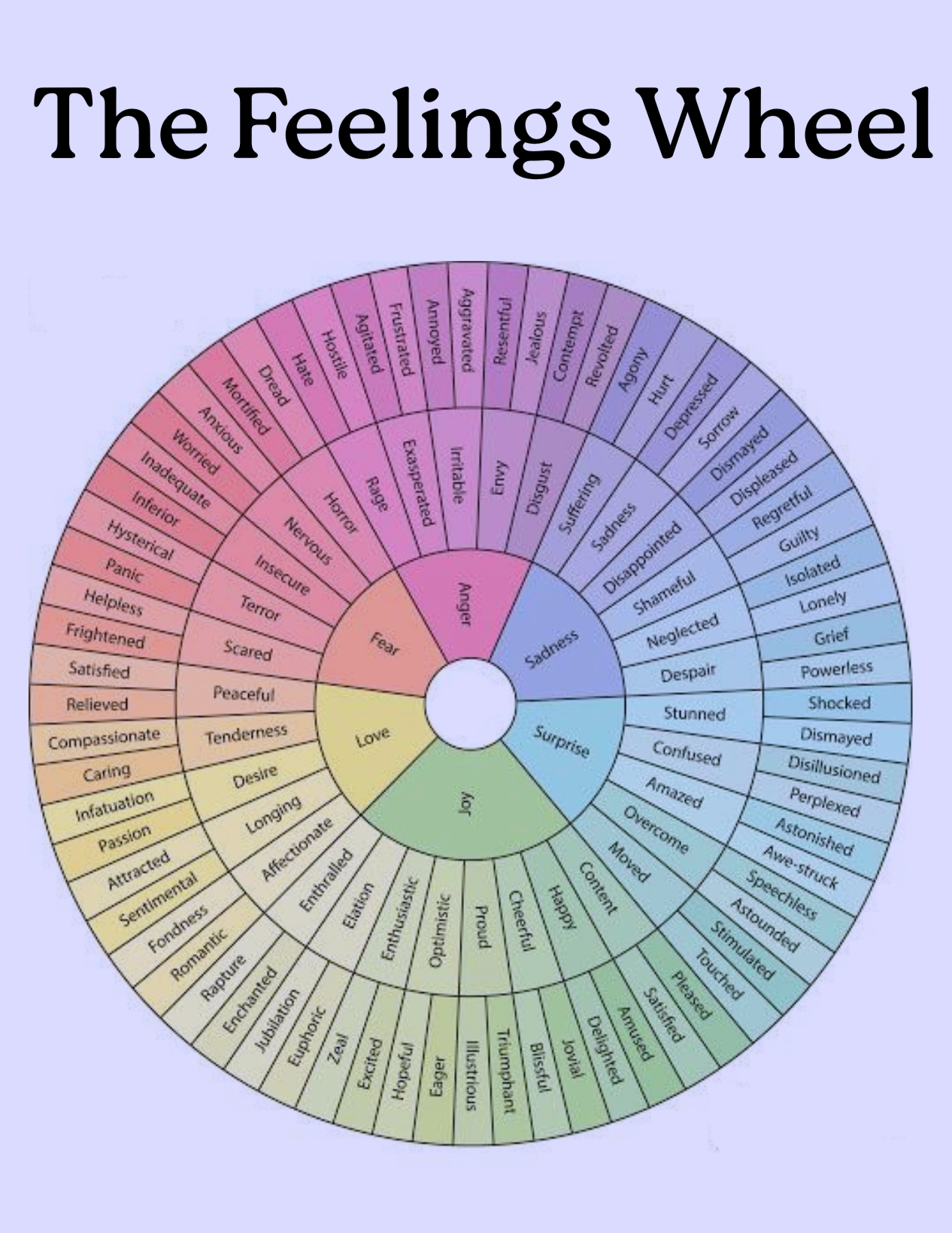
One of the things I often discuss with clients is that emotions are connected.
What we think of as a primary emotion often has many layers underneath it. Emotions don’t show up in a single, simple form. They tend to be layered, influenced by our experiences, our thoughts, and the context we’re in.
For example, someone might feel sad after a friend cancels plans. However, when we slow down and look a little closer, we may realize that underneath that sadness they are actually feeling disappointed, embarrassed, or hurt. While the first emotional label might be “sad,” the deeper experience is often more layered than that.
This is one reason emotion feelings wheel can be so helpful. They remind us that there is often more to our emotional experience than simply feeling “mad” or “sad.”
The more specific we can become, the more clearly we can understand what we need.
Every Emotion Has Something to Tell Us
I think one of the biggest misconceptions about emotions is that some emotions are good and some emotions are bad.
While some emotions do not feel good, it makes sense that we would jump to label them as bad. However, just because they do not feel great to feel does not actually make them bad.
Emotions are information.
They tell us something about our experiences, relationships, needs, and environment.
Take anger, for example. Anger often gets a bad reputation, but anger is a protective emotion. It can show up when a boundary has been crossed, when something feels unfair, or when an important need is not being met.
The goal is not to get rid of anger. The goal is to understand what it may be trying to tell us.
The same is true for sadness, fear, guilt, shame, disappointment, and joy. Each emotion carries information.
Emotion Regulation Starts Here
When people think about emotion regulation, they often think about calming down, taking deep breaths, grounding, or using coping skills.
Those things can be helpful. Grounding skills can help our nervous system settle enough for us to think clearly and respond more intentionally.
However, if we stop there and never look at the emotion itself, we may not be getting our underlying needs met. Sometimes coping skills can become a temporary bandage rather than a way of understanding what is actually happening inside us.
Before we can effectively regulate an emotion, we have to identify it.
If we do not know what we are feeling, it becomes much harder to understand what we need or how to respond effectively.
The first step in emotion regulation is not controlling emotions.
It is recognizing them.
Because you cannot regulate what you cannot identify.
I challenge you to take notice of how often you describe yourself as feeling “fine.”
When you catch yourself using that word, pause for a moment and ask:
What am I actually feeling?
Is there a more specific emotion underneath the surface?
What might this emotion be trying to tell me?
You may discover that “fine” was never the whole story.