

ADHD, Goal Setting & the Fear of Losing Momentum
Living with ADHD often means riding waves of motivation that can feel unpredictable. Many people fear that if they pause while working toward a goal, they’ll lose momentum and never start again. This blog explores why that fear exists, how “all-or-nothing” thinking shows up, and practical strategies to build restart points, trust natural rhythms, and make progress without burning out.
Living with ADHD often means living with big dreams and just as big frustrations. You might have heard—and even tried—the classic advice: “Break big goals into small steps.”
And yet… even when you know that strategy works, you might avoid it. Why?
For many people with ADHD, there’s a hidden fear at play:
“If I stop, I might never start again.”
That worry can shape the way you approach motivation, productivity, and even your sense of self-trust. Let’s break down why this happens—and what can help.
The “All-or-Nothing” ADHD Mindset
When you finally catch a wave of focus, it feels precious. You ride the momentum hard, because deep down you worry: “If I pause, I’ll lose it.”
This can lead to pushing yourself until exhaustion, skipping breaks, or resisting small steps in favor of “one big push.”
The reality is:
Momentum does sometimes fade.
That doesn’t mean you’ve failed.
It means your brain works in rhythms, not in straight lines.
The Avoidance Cycle
Another layer of this struggle is the avoidance cycle. When a task feels overwhelming—or when the fear of losing momentum kicks in—it’s easy to avoid starting altogether. Avoidance is one of those coping strategies that feels good in the moment but costs us more over time. So while avoidance is often used as a coping strategy, it is important to remember that it is a maladaptive way to cope despite the instant gratification we might feel in the moment.
Here’s how the cycle plays out:

Event – Something comes up that feels overwhelming, stressful, or uncomfortable. (Example: a big work task, paying bills, or even putting clothes away.)
Discomfort – Anxiety, fear, self-doubt, or overwhelm sets in. The body and brain signal: “This feels bad. Let’s escape.”
Avoidance – We decide to delay or not do the task. Maybe we scroll, distract, or walk away.
Instant Relief – For a short while, it feels better. The stress quiets down and we feel like we’ve escaped the pressure.
Increased Stress & Shame (Long-Term) – The problem hasn’t gone away; it’s still waiting. Now, guilt, shame, and more pressure build on top of the original discomfort.
Then the cycle repeats. Each time we avoid, the momentary relief teaches our brain that avoidance works—even though the long-term cost is higher. Over time, the discomfort and shame multiply with each round. That makes the task feel bigger, scarier, and more loaded the next time we face it. It’s not just about the task anymore—it’s also about the shame of not doing it earlier.
Avoidance works in the short term because it relieves the pressure. Think about doing the dishes. At first, leaving them in the sink feels easier than tackling them right away. Avoiding them brings a quick wave of relief.
But the longer you wait, the more the pile grows—and the harder it feels to start. Suddenly, a simple 5-minute task looks like a mountain. We go from a couple dishes in the sink, to a sink filled with dishes overflowing on to the countertops.
ADHD often magnifies this pattern. Small steps get delayed until they feel impossible. Avoidance builds on itself. And shame starts to whisper: “Why can’t I just do this?”
Shame & ADHD
This is where the shame spiral kicks in. Many people with ADHD grow up hearing they’re “lazy,” “unmotivated,” or “inconsistent.” So, when momentum slips, shame rushes in to confirm those old stories. This ends up feeding into shame.
When we buy into shame’s narrative (“I’m lazy,” “I’ll never get it together,” “Something’s wrong with me”), it chips away at self-esteem in a few ways:
Identity fusion: Instead of seeing a behavior (“I avoided that task”), shame convinces us it’s an identity (“I am a failure”).
Erosion of self-trust: Each time shame takes over, it feels harder to believe we can follow through next time.
Internalized criticism: Over time, the voice of shame can sound like our default inner voice, making self-compassion feel unnatural or even undeserved.
The result? A fragile sense of self-worth that feels conditional on productivity or perfection.
When we replace shame with curiosity and compassion, the opposite happens:
Self-esteem strengthens (“I can struggle and still be worthy”).
Motivation shifts from fear-driven to values-driven (“I want to move toward what matters, not just away from failure”).
The avoidance cycle weakens, because mistakes become learning moments instead of proof of inadequacy.
Reframes can look like:
Avoidance is not laziness—it’s a coping strategy.
Shame is not proof of failure—it’s a signal you need more compassion, not criticism.
Progress isn’t erased because you paused—you can always re-enter.
Instead of helping us “try harder,” shame drains energy, focus, and hope. Feeding into shame erodes self-esteem and sabotages motivation by keeping you stuck in avoidance—whereas compassion restores trust in yourself and makes small, sustainable action possible.
Willingness vs. Waiting for Motivation
One powerful skill for breaking the cycle is willingness.
Instead of waiting for the perfect wave of motivation, willingness asks:
Am I willing to take one small step, even if I don’t feel like it right now?
This could look like:
Washing just one plate instead of the whole sink.
Opening your computer, even if you’re not ready to write.
Setting a timer for 5 minutes to “just start.”
Willingness lowers the stakes. It builds trust that you can move forward without waiting for the “perfect” mindset.
Practical Tools to Break the Cycle
1. Name the Fear
When you catch yourself hesitating, say it out loud:
“I’m afraid to stop because momentum matters to me.”
“This isn’t procrastination, it’s me protecting my focus.”
Naming it softens the shame.
2. Create Gentle Restart Points
Think of these as bookmarks for your brain.
“Next time, I’ll just open the file.”
“Tomorrow, I’ll reread the last sentence I wrote.”
Restart points reduce the pressure of “starting from scratch.”
3. Practice Willingness
Ask yourself: “What’s the smallest step I’m willing to take right now?” Then do only that.
4. Trust the Cycle
Focus will ebb and flow. That’s ADHD reality—not a personal flaw. Remind yourself:
Pausing is not quitting.
Breaks protect energy.
Momentum can be rebuilt again and again.
Final Takeaway
If you live with ADHD, you don’t have to finish everything in one sitting. You don’t have to fear pauses. You don’t have to drown in shame when motivation slips.
Your progress doesn’t have to look perfect to be meaningful. With willingness, gentle restart points, and a compassionate view of the cycle, you can move toward your goals—without burning yourself out in the process.
Let’s Talk About Body Image
In a world filled with edited images and unrealistic beauty standards, it’s no wonder so many of us struggle with body image. But your worth has never been tied to numbers on a scale or how you compare to what you see online. Healing begins when we shift the focus away from changing our bodies and toward changing the pressures around us—cultivating compassion, rejecting harmful media messages, and understanding where we fall on the body image spectrum.
Because how you see yourself matters, and you’re not alone in the struggle.
Every day, people of all shapes, sizes, and backgrounds silently wrestle with body image. In a culture filled with filtered photos, comparison traps, and unrealistic standards, it’s easy to feel like your body isn’t “enough.”
You might sometimes feel like your body isn’t enough, but your worth has never been about numbers, sizes, or chasing perfection.
What Body Image Really Means
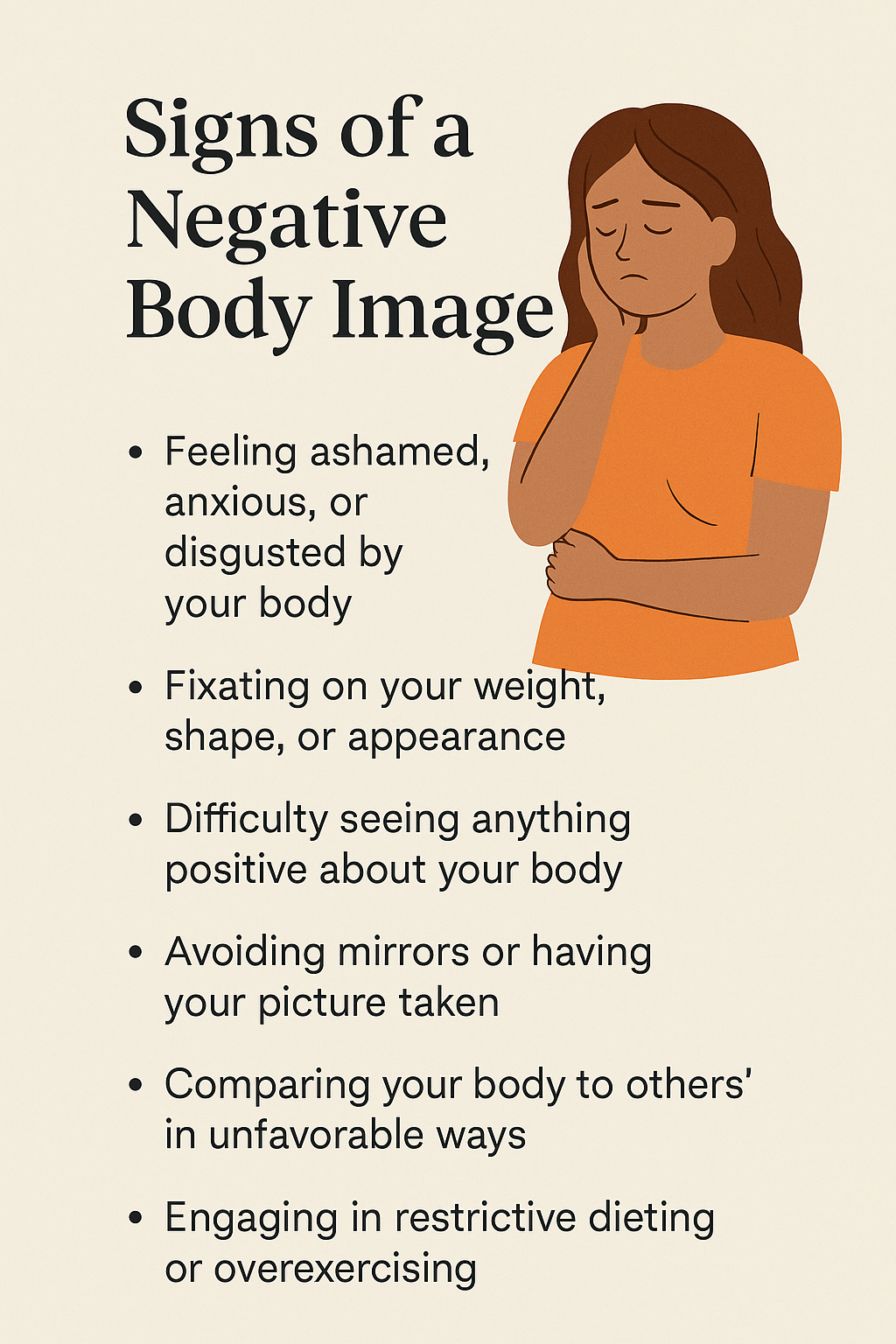
Body image is more than just how you look. It’s how you see, feel, and think about your body.
It includes your self-talk when you look in the mirror.
It shows up in how comfortable you feel in clothes, social settings, or even in your own skin.
It can shape your confidence, relationships, and mental health.
When body image turns harsh or critical, it can chip away at self-worth and feed patterns of shame, dieting, or self-punishment.
The Real Problem: Pressure, Not Your Body
We live in a culture that often glorifies thinness, perfection, or “transformation” as the ultimate goal. Social media filters, curated images, and comparison culture reinforce the lie that there’s only one acceptable way to look.
But the truth is:
Your body doesn’t need to change. The pressure does.
It’s the unrealistic standards that are harmful, not your body.
Scarcity Culture and Body Image: Why “Never Enough” Keeps Us Stuck
Brené Brown describes scarcity culture as the constant hum of “never enough.” We wake up thinking we didn’t get enough sleep, spend the day worrying we’re not productive enough, and fall asleep convinced we didn’t accomplish enough. This mindset doesn’t just shape how we measure success—it seeps into how we see ourselves, especially our bodies.
When scarcity culture meets body image, it can sound like this:
I’ll never be thin enough.
I’ll never be toned enough.
I’ll never look young enough.
I’ll never be disciplined enough to “stick with it.”
The rules keep shifting, and the finish line keeps moving. No matter how hard we try, it feels like there’s always another flaw to fix, another standard to chase. Our bodies stop feeling like home and start feeling like projects under construction.
The cruel part? Shame and scarcity feed each other. The more inadequate we feel, the more we double down on diets, punishing workouts, or self-criticism—hoping that this time, if we just work harder, we’ll finally feel enough. But that sense of worthiness never arrives, because the culture we’re swimming in is designed to keep us striving and unsatisfied.
Eating Disorders, Media, and Body Image: The Messages We Absorb
We don’t develop eating disorders in a vacuum. While genetics, trauma, and environment all play a role, the culture we live in—especially the media we consume—shapes how we see our bodies and what we believe about our worth.
From magazine covers to TikTok trends, we’re flooded with narrow and unrealistic standards of beauty. Thinness is celebrated. “Clean eating” and hyper-fitness are praised. Filters and editing erase natural bodies and turn them into impossible ideals. The message we receive, over and over, is: your body is not enough as it is.
For someone vulnerable to disordered eating, these messages can act like fuel. A perfectly normal body suddenly feels unacceptable. Food becomes a battleground. Exercise becomes punishment instead of self-care. And the cycle of shame, restriction, and overcompensation deepens.
The impact doesn’t stop with individuals—it becomes cultural. Media creates a hierarchy of bodies: thin over fat, youthful over aging, “fitspo” over rest. This hierarchy reinforces Brené Brown’s idea of scarcity culture, the sense that no matter what we do, we’ll never measure up.
Unfortunatly we start to forget that bodies in the media are not reality. They’re curated, edited, and filtered to keep us striving (and buying). And striving for an impossible standard is exactly what keeps us stuck in the loop of body dissatisfaction and, for many, eating disorders.
Understanding the Body Image Spectrum
Body image isn’t just “good” or “bad.” It exists on a spectrum, and people may move between different points depending on the day, the season of life, or their healing journey.
Here’s a simplified way to think about it:
Negative Body Image
Feeling uncomfortable in your body
Harsh self-criticism and shame
Preoccupation with appearance or size
Body Neutrality
Shifting focus from looks to function
Recognizing, “My body lets me walk, breathe, hug, and live.”
Accepting that you don’t have to love every part of your body to treat it with care
Body Respect & Body Acceptance
Meeting your body with care, regardless of appearance
Nourishing and resting your body because it deserves it
Building sustainable self-compassion instead of conditional acceptance
Body Positivity
Actively celebrating body diversity
Challenging beauty standards and embracing differences
Reframing your body as worthy of joy, pleasure, and representation
Wherever you find yourself on this spectrum, it’s important to remember: none of these points are about perfection. They’re about relationship. And like any relationship, it can evolve over time.
Shifting Toward Healing
Healing body image isn’t about “learning to love every part of yourself overnight.” It’s about building a kinder, more compassionate relationship with yourself over time.
Here are a few gentle starting points:
Notice your self-talk. When you catch harsh inner criticism, pause and ask, “Would I speak this way to a friend?”
Appreciate function over form. Your body allows you to breathe, laugh, hug, and move through the world. Gratitude for what your body does can soften how you feel about how it looks.
Build media literacy. Notice when images are edited or filtered and remember, comparison is unfair when the standard isn’t real.
Diversify your feed. Follow accounts that celebrate body diversity, recovery, and authenticity.
Call out diet culture. When you see media praising restriction or shaming bodies, recognize it as harmful messaging not truth.
Practice self-compassion. Healing begins with kindness towards yourself. This means meeting yourself with patience on the tough days, and reminding ourselves that our worth is not up for debate, no matter what the media tells you.
You’re Not Alone
If you struggle with body image, know this: you are far from alone. Many people carry the same quiet battle — but silence makes it heavier.
The more we name these pressures, challenge them, and support each other, the more freedom we can create.
Your worth is not defined by a number, a size, or a reflection. You deserve to live in your body without shame — and to meet yourself with the same compassion you’d offer anyone you love.
Healing starts when we stop punishing ourselves and start showing kindness to ourselves instead.