
When Your Child Is Falling Apart… and You’re Trying Not To

There are moments in parenting that just don’t make sense.
Your child is having a big reaction, crying, yelling, shutting down, and you’re standing there thinking, this doesn’t make sense… we’ve talked about this… I even got up 20 minutes early so this wouldn’t happen… why is this still happening?
And right there in the middle of it, you can feel your own emotions start to rise too. Frustration. Overwhelm. Sometimes even helplessness.
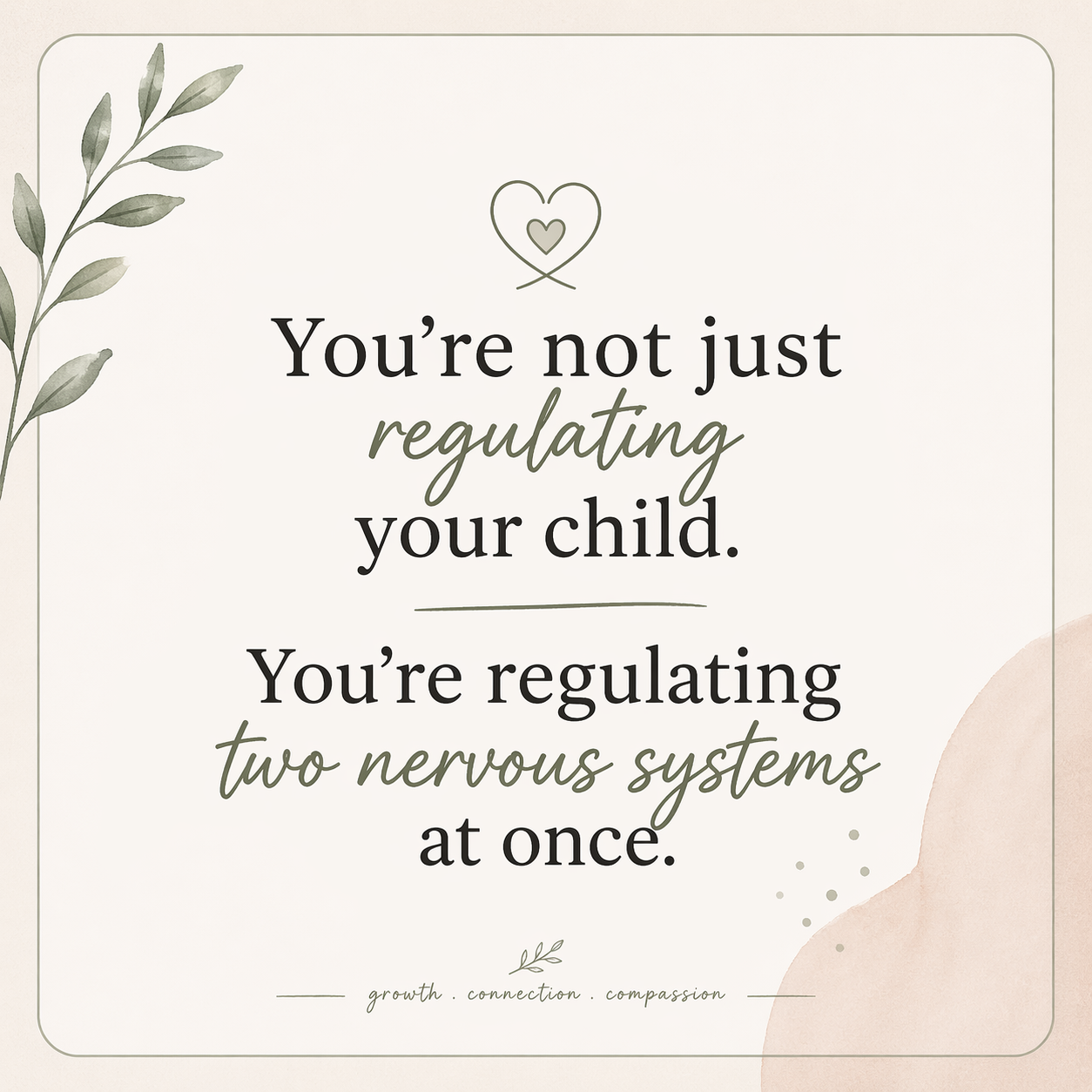
Because what often goes unspoken is this: in these moments, you’re trying to regulate two nervous systems at the same time. Your child’s and your own.
That’s a lot to carry.
Meltdowns vs. Tantrums
Sometimes what you’re seeing is a true meltdown. Your child is overwhelmed. Their system is overloaded, and in that moment, they don’t have access to the skills you know they have. It’s not that they’re refusing to use them, it’s that they literally can’t. Logic and reasoning don’t land because their brain is in survival mode. It can look like defiance or a child being difficult, but underneath it, they can’t calm down.
Other times, it may look more goal-driven. A push to see if something changes. A louder voice or bigger reaction to try to get a need met.
Honestly, these two can overlap and shift quickly.
But instead of getting stuck on labeling it perfectly, it can be more helpful to simply pause and ask: is my child overwhelmed right now, or are they trying to influence an outcome?
That can completely change how you respond.
Before You Respond, Check In With You
In these moments, there’s another step that gets missed all the time: checking in with yourself. As parents it’s second nature to put our child first. We don’t even think about it.
And sometimes, it can even feel selfish to pause and turn inward for even a second. My child is screaming… struggling… I need to fix this right now. I don’t have time to focus on me.
It can feel a bit like rushing out the door in the morning, your child is ready for school, but you’ve just thrown a hat on your head and a pullover over your pajamas. You’re technically “out the door,” but you haven’t actually had a moment to get yourself together.
That’s why we need to start asking ourselves, “where am I right now?” when our child is experiencing loud emotions.
Because your nervous system is in it too. You’re reacting, feeling, absorbing the intensity in the room.
And if you’re already at your limit, it becomes so much harder to stay steady in a way that actually helps things de-escalate.
This is where that “airplane oxygen mask” idea really matters. We have to make sure we are appropriately equipped to support, otherwise we won’t be of any use to anyone. Not as a perfect skill, but as a quick pause. A breath. A moment of awareness. A reminder that you don’t have to respond at full speed or full intensity.
You just have to be grounded enough to not add more fuel to what’s already happening.
Resolution Comes Later
The instinct in these moments is often to fix it. To talk it through. To explain. To make it stop.
For example, we might try to rehash rules, explain why the behavior wasn’t appropriate, and what should have happened instead. And what we often see is either the child’s behavior escalates further, turns into arguing, or they just straight up aren’t able to listen to us at all.
That’s because when a child is highly escalated, they’re not in a place where any of that can land.
They don’t need a lesson in that moment. They need support regulating their system first.
So the goal shifts. Less talking. Less teaching. More presence. More steadiness. Sometimes just sitting nearby and being a calm point in the middle of their storm is enough.
The processing, the teaching, the “what can we do differently next time” still matters. It just comes later, when their nervous system is back online.
The Bigger Picture
If this feels hard, it’s because it is hard.
You’re not just managing behavior. You’re navigating emotional intensity, supporting a dysregulated child, and managing your own internal reactions while it’s all happening in real time.
It’s incredibly hard to hold all of that at once.
We are human. As much as we want to be regulated at all times, especially with our children, there are going to be moments where emotions get the better of us. And in those spaces, we need to give ourselves grace.
Maybe I used a harsher tone than I should have. Maybe I jumped in too quickly. Maybe I tried to fix it before anyone was ready.
And instead of staying stuck there, we can pause and ask: how am I going to show up differently next time?
Not from a place of self-criticism, but from a place of building awareness.
Because sometimes the most important moment isn’t the one where everything goes well. It’s the one where we notice after the fact: that didn’t land the way I wanted it to.
And we come back to it anyway.
That’s the part our kids learn from.
Not that we get it right every time, but that we come back even after we don’t.