
What If Loving Your Body Doesn’t Mean Loving It All the Time?
Why body image can feel so hard
I think a lot of times body image feels like such a struggle because we’re coming from two places at once.
First, we may already be starting from body dissatisfaction or even body hate.
Second, there’s this idea that the goal is to eventually get to a place where we absolutely love our body no matter what, and that we’ll never have negative thoughts about our body again.
That’s a really high bar. And honestly, it’s not very realistic.
We don’t reach a point in other areas of growth where we suddenly become immune to self-doubt or struggle. Even when we grow, we still have hard moments. We still disengage from our values sometimes. We still question ourselves. Growth changes how we respond, it doesn’t eliminate difficulty or uncomfortable feelings. That is why we call it growing pains. I think it’s helpful to consider that body image works in a similar way.
Holding the dialectic
Getting into a healthier space with body image is more about holding two truths at the same time.
We may have moments where we’re feeling dissatisfied with our body in some way, and we can also still hold onto the fact that we ultimately like our body and appreciate it.
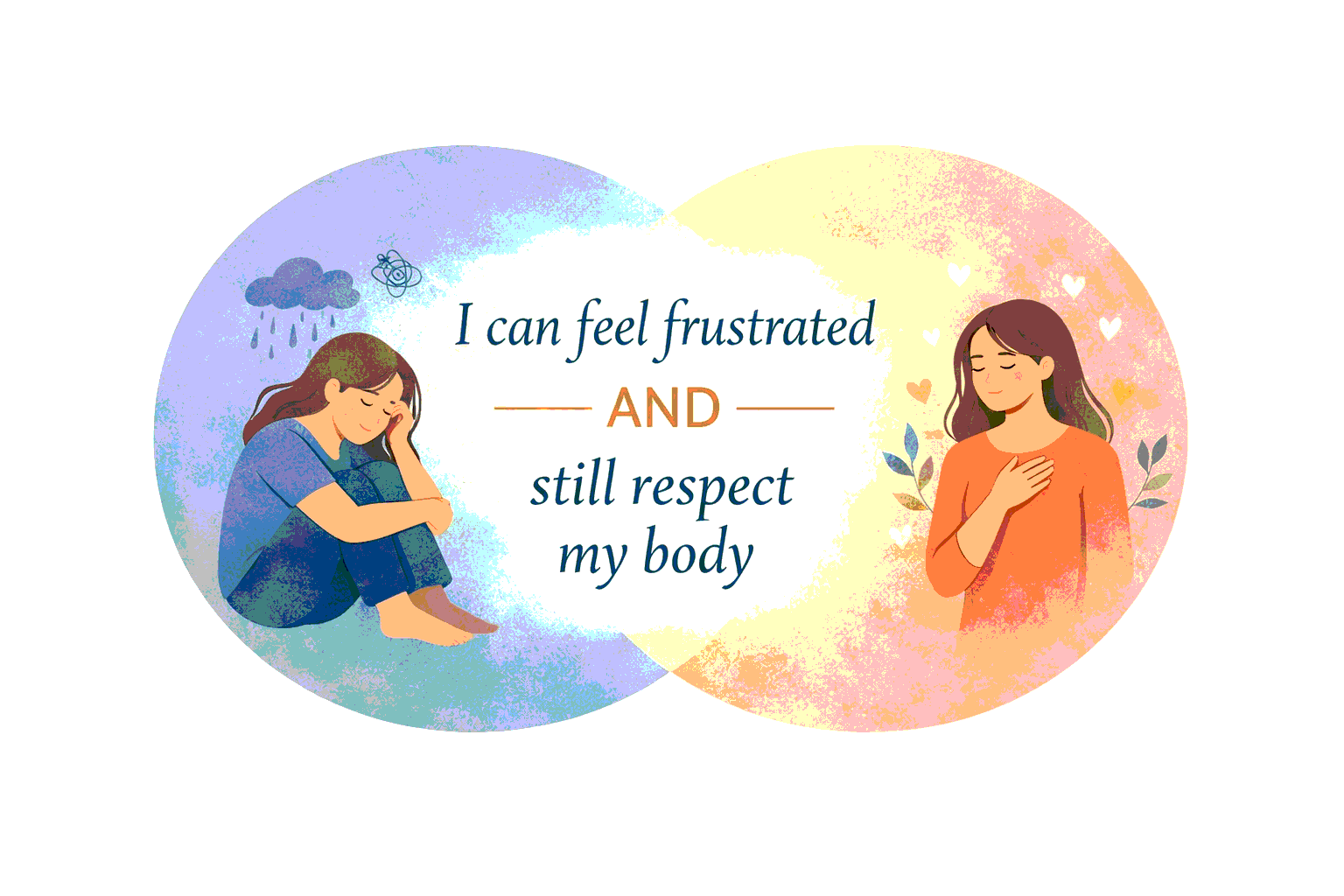
Both things can exist at the same time, and can be equally valid. Just because we may be feeling dissatisfied in our body, it doesn’t undo the fact that we also still overall feel body respect or appreciation. Likewise, we don’t have to ignore or invalidate feelings of discomfort that we may be experiencing in the moment. One doesn’t take away from the other.
I also want to recognize that when we’re at the beginning of this work, it can be really hard to even identify this balance. Sometimes the thought is, What do I even like about my body? That’s okay. This is something that develops over time.
Sometimes the first step isn’t loving or even liking our body. It’s just starting to treat our body with a little more respect, even when those critical thoughts are still present.
The “bad hair day” example
A simple way to think about this is having a bad hair day. It’s unrealistic to think that once we get to “body appreciation,” we’ll never have a bad hair day again. We can’t control the weather. Humidity happens. Wind happens. Rain happens. Or maybe we just sleep funny and it messy up our hair for the day.
We might think:
My hair looks flat today.
Why is that piece sticking up like that!?
My hair just isn’t sitting right.
But that doesn’t have to spiral into self loathing. We can still hold onto the bigger picture that overall we like our hair, or appreciate certain things about it, like its thickness, length, or that it’s healthy.
We can feel annoyed and still appreciate it. Both can be true.
Thinking about your body as a relationship

It can be helpful to externalize our body and think of it as a relationship we’re maintaining. In any relationship, there are going to be disagreements or moments of frustration. What matters is how we respond in those moments.
Do we scream and yell? Do we punish someone when we feel they’ve done something wrong? If we treated our friends that way, we might lose those relationships. But our body doesn’t get the choice to walk away. It has to endure whatever we direct toward it.
So the question becomes:
How do I handle disagreements with my body?
What does healthy resolution with my body look like?
What kind of repair work do I need to do to improve this relationship?
A different goal
This is where a more dialectical perspective can be helpful, as mentioned earlier. Dialectics reminds us that two things can be true at the same time. I can have a negative thought about my body, and still respect it. I can feel dissatisfied in a moment, and still appreciate my body overall.
So with body image, the goal isn’t to ride off into the sunset thinking “I love my body” and never having another negative thought about your body again. The goal is being able to hold the dialectic when negative thoughts show up, and responding in a healthier way when they do.
It’s less about perfection, and more about flexibility.
Less about eliminating hard thoughts, and more about changing our relationship and response to them.
The goal isn’t to love your body all the time. It’s to build a relationship with your body that can withstand the moments when you don’t.