
Values: Your Inner Compass
Life can feel unpredictable, messy, and full of moments that leave us wondering what direction to take next. You might feel like you’re doing all the “right” things and still end up unsure, overwhelmed, or disconnected from the life you imagined for yourself. That doesn’t mean you’ve failed. More often, it means you’re trying to steer without a compass.
That compass is your values.
Values are the guiding principles that help us choose how to move through the world. They give our days direction and our choices meaning. When we understand our values, we begin to understand ourselves not just who we are, but the kind of person we want to become.
If you read our previous article on living with intention you might remember the image of being in a boat without a paddle, just drifting wherever the current takes you. That metaphor still rings true here. When you know your values, you pick up the paddle. You steer. And what we’re unpacking now is how to know which way you want to steer, by clarifying your values, understanding the messages your emotions send, aligning goals behind what matters, and choosing to live more intentionally.
What Are Values?
Values are the qualities, ways of being, or themes that matter deeply to us. They aren’t rules or expectations, and they’re not about what other people say should be important. Think of them more like the wind that fills your sails. They help create a steady source of motivation and direction that helps you move toward a meaningful life.
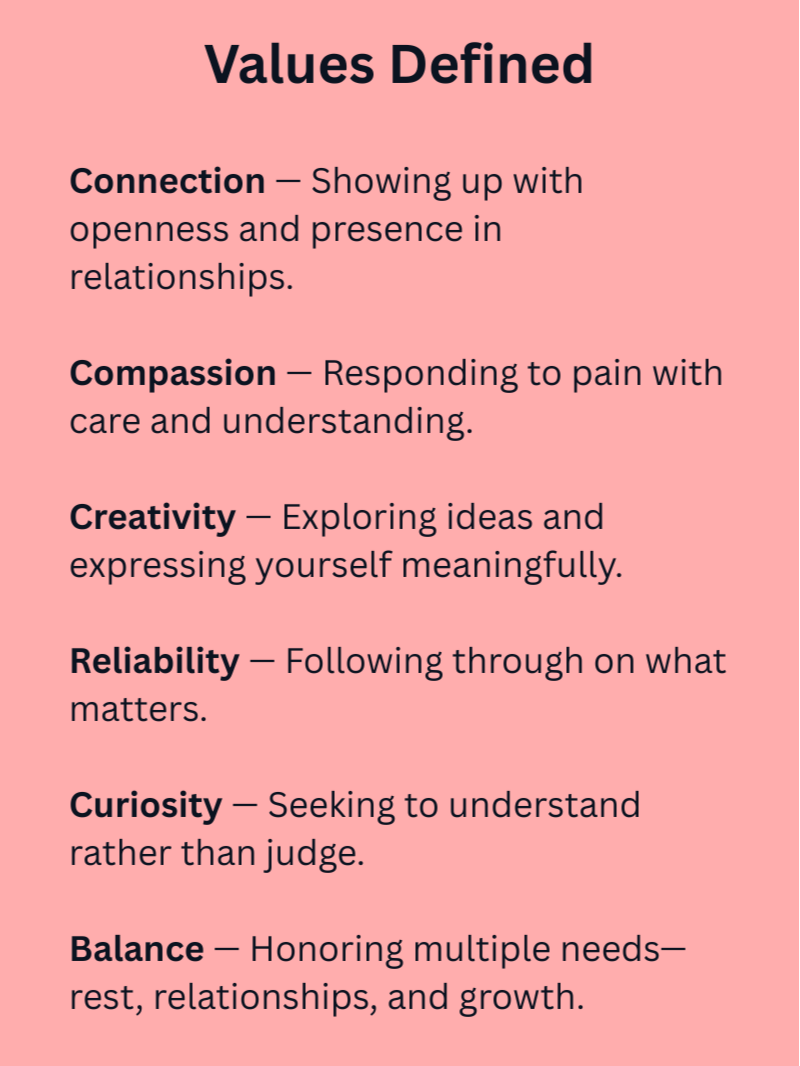
Someone may value creativity, while another values reliability, play, compassion, or adventure. You might care deeply about curiosity in your work and connection in your closest relationships. None of these are right or wrong; they simply reflect what matters most to you.
Values are ongoing. You never “finish” kindness or integrity. They’re not tasks you check off a list, they’re qualities you practice, again and again. Goals can be completed; values stay with you, guiding how you show up each day.
Something that often gets missed in conversations about values is how personal they are. Two people can share the same value, yet define and live it in totally different ways. For example, someone who values connection may think of regular phone calls with loved ones, while another expresses that same value through hosting dinners, quality time, or simply being fully present during conversations. Neither is “more right” they’re just different interpretations of the same core value.
That’s why it’s so important to define your values in your own words. Without that clarity, it’s easy to get pulled into what you think a value “should” look like rather than staying true to what feels most authentic. When you understand what a value means to you, it becomes easier to notice when you’re living it, when you’ve drifted from it, and how you might lean into it more intentionally.
Why Values Can Feel Confusing
In my work with clients, I often hear people say they “know” their values. And in a broad sense, many do. They may identify with a long list of ideas such as honesty, family, creativity, balance, or achievement. However when we begin exploring more deeply, people are often unsure which values are their core values and which are simply qualities they feel they should care about.
This confusion makes a lot of sense. Most of us were never taught how to define our values, let alone how to organize them. When you look at a long list, it’s easy to assume all values should be equally important. But that belief can leave us overwhelmed and stuck.
We cannot actively embody all values all the time. It’s simply not possible. Trying to honor every value at once can create pressure rather than clarity. Instead of guiding us, values begin to feel like another task list we’re constantly failing to complete.
Clarifying which values are central in your life allows you to make choices with more ease. It doesn’t mean you ignore everything else; it just means you are choosing direction based on what is most important in this season of life. Naming a smaller set of core values allows you to move with intention rather than getting pulled in every direction at once.
How Emotions Help Us Understand Our Values
Our emotions can be some of the clearest signals of what matters to us, almost like a built-in notification system. When a feeling shows up (especially the uncomfortable ones), it’s often pointing toward a value that was touched, threatened, or honored.
Guilt is a common example. It doesn’t always mean you did something “wrong.” Sometimes guilt simply shows up when we’ve stepped away from something that feels important. If someone tells a lie and immediately feels unsettled, that reaction may be their internal signal that honesty is a value they want to live by.
Emotions can also show up when two values pull in different directions. Think about a moment where you’ve had to cancel plans with a friend because a family need came up. You honored your value around family, but guilt may still surface because dependability or commitment also matters to you. Both values are valid, your emotions are just reflecting the tension between them.
Even more subtle feelings can highlight what we care about. Sadness after a friend moves away can show how much connection matters. Frustration in an unfair situation can highlight a strong value around justice or respect. Anxiety may reveal a desire for stability, clarity, or safety.
Emotions aren’t always comfortable, but they’re meaningful. When we treat them as information instead of problems, they can help us identify which values are asking for attention and guide us back toward what feels aligned.
Finding Your Core Values

Knowing your values is one thing. Knowing which ones are your core values, the ones that truly guide your decisions and give your life direction, is another. Many people have a long list of values, however they often get stuck on how to narrow that list it down to the few values that really matter most.
A practical approach is to look for patterns in your choices over time.
When tough decisions arise:
-Which principles consistently guide you?
-Which values are non-negotiable?
These repeated priorities are usually your core values.
It’s also helpful to consider your motivations behind your goals and actions. Ask yourself: Why does this matter to me? If your answer connects to a deeper principle, that principle may be one of your core values.
Your core values are the ones that persist, even when life gets complicated.
Putting Values Into Action
Knowing your values is helpful, but the real change happens when you begin using them to guide how you live. This doesn’t have to involve sweeping life changes. Small steps can be incredibly meaningful.
Someone who values growth might begin trying new things, even if they feel unsure or awkward. A person who values connection might send a message to someone they care about. Someone who values health might begin prioritizing sleep or adding movement into their day. A person who values creativity might carve out a few minutes to write, paint, or build something.
In “Living With Intention,” we talked about small intentional choices such as pausing before a response, scheduling time for what matters, tidying a space to clear mental clutter. Those are exactly the kinds of acts that come alive when your values are clear. With your values guiding the way, you can select intentional actions that reflect them, making it easier to steer toward what matters rather than just reacting.
Living by your values is about nudging your life in the direction that matters to you, little by little, until those small actions add up.
A Values-Aligned Life Isn’t Always Easy
There’s a common misconception that once you know your values, everything suddenly becomes easy. In reality, living by your values can be uncomfortable.
Aligning with your values might mean saying no when you want to please others, setting boundaries, being honest when it feels vulnerable, or making choices others don’t understand. It can require sitting with discomfort, including doubt, frustration, embarrassment, or fear.
Life also gets busy. Stress piles up. Routines take over. Sometimes, disconnecting from what matters feels easier in the moment because we may simply not have the energy. So when you notice you’ve disconnected from your values, it’s important to recognize that this is normal and will happen at times.
Living a values-aligned life isn’t about perfection. It’s a practice. It’s about noticing when you drift and gently coming back.
Your Life, Guided by What Matters Most
Values help us make choices that feel meaningful and authentic, even when life feels messy. They help us notice what we care about and move toward it. Checking in with yourself regularly can be helpful:
-What mattered to you today?
-Did your choices reflect what’s important to you?
-What got in the way?
-And what small step could you take tomorrow?
Values aren’t about meeting some ideal version of yourself. They’re about being intentional. When you keep coming back to what matters most, you shape your life in a way that leads to fulfillment.