
Why Motivation Is Not the Problem Especially for ADHD Brains
You wake up determined to clean the house.
You want to do it. You plan to do it. You even have time.
But when you start, your brain suddenly shows you everything at once. Dishes. Laundry. Clutter. Emails. The thing you forgot yesterday. The thing you should do before cleaning. The thing you should research before that.
The task instantly feels enormous. Your body slows down. You check your phone for just a second. Maybe you scroll. Maybe you wander. Maybe you organize one drawer instead.
Later nothing is done. And the thought appears
Why can I not just do it? I have no motivation.
But what if motivation was never the problem?
ADHD affects how the brain regulates attention, effort, and activation, not how much someone cares. What looks like a lack of motivation is often the nervous system struggling to initiate action.
Motivation vs Executive Function
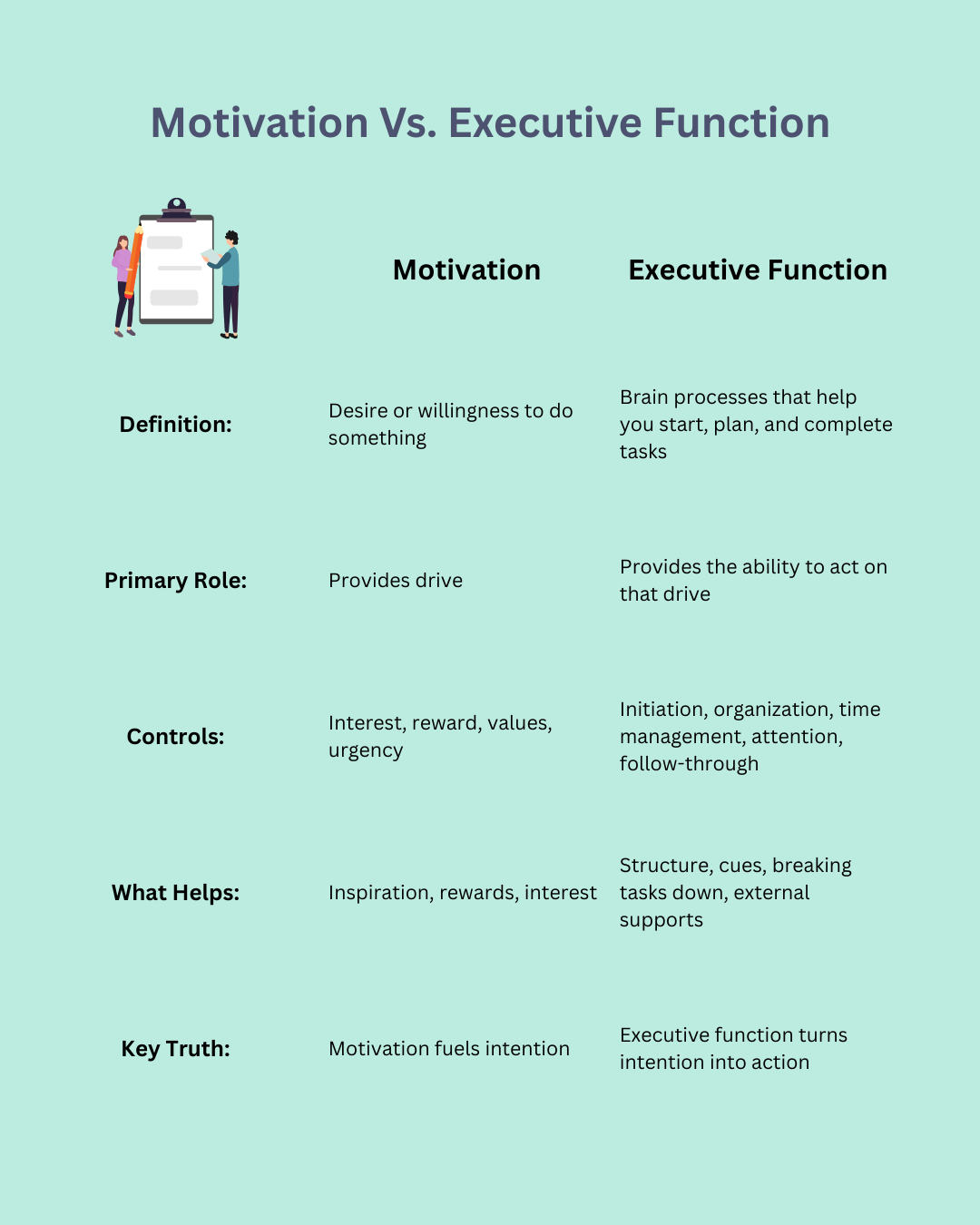
Most of us were taught a simple formula:
If you care you will do it.
This formula works for people whose executive functioning system runs smoothly. Executive functions are the brain’s management processes responsible for starting tasks, organizing steps, shifting attention, managing time, and sustaining effort.
When those systems struggle, the real equation looks more like:
Care deeply → Brain overload = Stuck
You are not failing to act because you do not want to or your lack motivation. You are stuck because the system that translates intention into action gets jammed. Motivation determines whether you want to do something. Executive function determines whether you can start and follow through.
What Executive Dysfunction Really Feels Like
From the outside it can look like procrastination. On the inside it often feels like paralysis.
Many people describe it as knowing exactly what they need to do but feeling unable to begin, like their brain is pressing the brake pedal while they are trying to move forward. They may sit in discomfort watching time pass, they may pace or start doing an unrelated task, while wanting to act but feeling mentally blocked.
This is why it is important to clarify that this is not a motivation problem.
It is a regulation problem. Executive dysfunction is a neurological regulation issue, not a character flaw.
Why Shame Makes Everything Harder
Another obstacle that often gets in the way of people being able to follow through on tasks is shame.

Some people will argue that “tough love” is way they can motivate themselves; however, it is important to note that shame blocks action.
When your internal voice says things like I am lazy, I should be able to do this, or What is wrong with me, your nervous system interprets that as threat. When the brain detects threat, it shifts resources away from planning, focus, and initiation, and shifts focus towards a survival mode: fight, flight, freeze or fawn response.
In other words, shame shuts down the exact skills you need in order to start.
The Hidden Truth About “Unmotivated” People
Most people who think they lack motivation actually care too much, not too little.
They often carry constant internal pressure. They mentally track unfinished tasks, worry about falling behind, and hold themselves to very high standards. That pressure builds until the brain becomes overloaded and overwhelmed and stops initiating.
This is not refusal, this is their nervous system trying to protect them.
Once people understand this is not a character flaw, they often begin to recognize a pattern they have been stuck in for years.
A Pattern You May Recognize
Once people realize this is not a character flaw, they often start noticing a pattern they have experienced over and over but never had language for. It is not random. It follows a predictable loop.
For example, imagine you notice the dishes in the sink. You tell yourself you should do them. Almost immediately you feel resistance in your body. The task suddenly feels bigger than it actually is. You think about how long it will take, how tired you are, how many dishes there are. Starting feels hard. Then the thoughts show up. Why am I like this? This is so simple. I should have done this already.
Now the discomfort is stronger, not weaker. So you walk away and check your phone or sit down for a minute. The moment you step away, you feel a small wave of relief. The pressure drops.
Later, though, the dishes are still there. And now the relief has been replaced with more shame, more dread, and a stronger urge to avoid it next time.
This is the cycle.
The Avoidance Cycle
Many people with ADHD traits find themselves in a predictable loop.
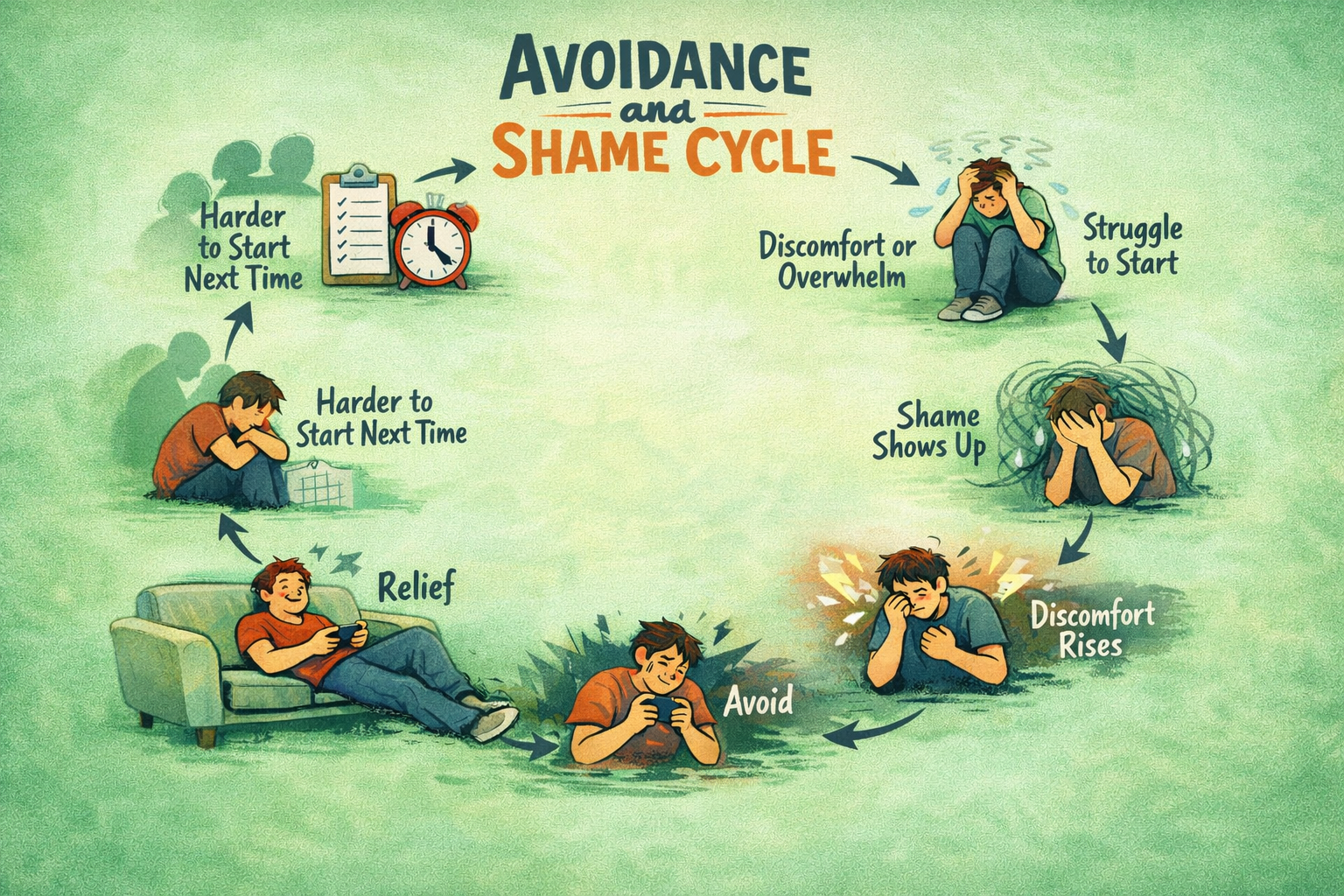
When a task comes up, it can trigger feelings of discomfort or overwhelm, making it hard to get started. As shame creeps in, that discomfort grows, leading to avoidance. While avoiding provides brief relief, the shame lingers and builds, making it even harder to tackle the next task. This cycle can repeat over and over, showing how avoidance and shame reinforce each other.
Avoidance is not proof that you do not care. It is your brain trying to reduce discomfort. Distraction is a short term relief strategy that calms the nervous system temporarily. But afterward the task is still there, however now it is layered with guilt.
Shame acts like glue in this cycle. It keeps you stuck while convincing you the problem is your character.
How to Tell It Is Executive Dysfunction Not Laziness
There is an important difference between not wanting to do something and being unable to start.
Signs that executive functioning may be the issue include difficulty starting even tasks you care about, doing well under urgency but struggling without deadlines, starting strong but not sustaining momentum, or finding it easier to complete tasks when someone else is present.
Laziness means you do not want to do it.
Executive dysfunction means you want to but your brain is struggling to turn that want into action.
This distinction matters because the way we approach these two things are completely different.
What Actually Helps
Before strategies work, it helps to understand that difficulty starting is not resistance. It is a regulation barrier. If motivation is not the problem, pushing harder will not fix it. What helps is reducing friction between intention and action.
Creating external structure, breaking tasks into small steps, paying attention to sensory input, and practicing supportive self-talk can make it easier to help your brain take action and follow through.
One of the most powerful shifts is changing your internal question from:
Why can I not do this?
to
What would make this easier to start or what is one thing I can do for the next 5 minutes
That question moves you from shame into problem solving, and problem solving is where momentum begins.
Take Away
Struggling to start tasks does not mean you are lazy.
It does not mean you lack discipline.
It does not mean you do not care.
Often it means your brain needs different supports than the ones you were taught to use. This distinction matters not just emotionally but practically.
Understanding executive dysfunction does not mean lowering expectations. It means changing the strategies we use to address what is actually getting in the way. When we do that, people often realize the issue was never an inability to follow through. They are far more capable than they have been led to believe.
If this resonates with you, there is nothing wrong with you. You may simply be using motivation-based solutions for a regulation-based difficulty.
And those require entirely different tools.